
Sisters of the Holy Cross Partner with Other Midwest Congregations to Open New Research Center
On May 26, the Heritage and Research Center at Saint Mary's College (HARC) will mark an important milestone when Bishop Kevin Rhoades of the Diocese of Fort Wayne-South Bend visits campus to bless the new collaborative archive before an expected gathering of about 100 guests.
Though not yet open to the public, HARC began accessioning collections this spring, moving the long-planned center from vision into active stewardship. A sponsored ministry of the Sisters of the Holy Cross, HARC consists of ten congregations of Catholic sisters from the Midwestern United States:
- Our Lady of Victory Missionary Sisters (Huntington, IN)
- Sisters of the Holy Cross (Notre Dame, IN)
- Sisters of St. Casimir (Chicago, IL)
- Sisters of Charity of the Blessed Virgin Mary (Dubuque, IA)
- Sisters of the Most Precious Blood (O'Fallon, MO)
- Sisters of St. Agnes (Fond du Lac, WI)
- Sisters of St. Francis of the Holy Cross (Green Bay, WI)
- Servants of Mary/Servite Sisters (Ladysmith, WI)
- Sisters of Mercy of the Holy Cross (Merrill, WI)
- Sisters of the Divine Savior (Milwaukee, WI)
How They Came Together
The first seeds for HARC were sown in April 2018 when 52 people representing 27 congregations of women religious gathered for a "Day of Dreaming" at the invitation of the Sisters of the Holy Cross at their motherhouse, Saint Mary's—which shares a campus with the women's college they founded, Saint Mary's College, in Notre Dame, Indiana—to gauge the interest of other congregations in joining in a collaborative project to house, care for, and make accessible their archives.
On this "Day of Dreaming," the Holy Cross Sisters shared their vision and invited others to participate. Together, they envisioned an archival center open to researchers and a heritage center not simply focused on the past but documenting that past and how that heritage lives into the future. Never intended to be merely a repository, HARC would be a living center of scholarship, storytelling, and encounter. Situated on the campus of Saint Mary's College and near the University of Notre Dame and Holy Cross College, HARC is uniquely positioned to serve as a regional and national hub for the study of Catholic women religious.
Beginnings
Following the initial meeting, a steering committee of representatives from four of the congregations was created to move the project forward. The steering committee focused on identifying the next steps to bring the collaborative to fruition, which included gathering preliminary information on the cost of renovating versus new construction, identifying existing buildings that could be renovated to house the archives, and identifying potential funding sources. Other steps included surveying interested congregations on the size, scope, and budget of their collections, as well as contacting archivists who were already engaged in forming a collaborative archive.
In April 2019, the Sisters of the Holy Cross hosted a follow-up meeting to the original Day of Dreaming. Representatives from ten congregations and Saint Mary's College attended. At this meeting, people shared information about their congregation and its history and mission. They also shared wants, needs, and hopes for the collaborative. Attendees committed to moving the project forward. In support of this, a representative from each congregation and the college was added to the steering committee.
The newly expanded steering committee met in fall 2019 to make the dream of 2018 a reality. At this meeting, the group developed a mission statement and named the endeavor "the Heritage and Research Center at Saint Mary's: A Collaborative Archive of Women Religious and Their Sponsored Ministries."
The steering committee also formed a seven-person board of directors, incorporated in Indiana, became a non-profit 501(c)3 organization, and was listed in the Official Catholic Directory. The committee also shared its vision with Bishop Kevin Rhoades of the Diocese of Fort Wayne-South Bend.
HARC asked each congregation to conduct a space study of its archives. Congregations were asked to calculate how many linear feet of archival material made up their collection, what types of material made up the collection (manuscripts, bound materials, photographs, etc.), and how that material was stored (archival boxes, filing cabinets, flat files, etc.). Each congregation also determined how much space it would need for non-archival materials such as artwork, furniture, and textiles. While HARC did not place limits on the amount of non-archival material a congregation can include as part of its collection, HARC asked each congregation to carefully consider how this material contributed to its story and only send items that are important to that story. HARC also assisted congregations that did not have the ability to carry out a collection survey.
Building a Home
Once information about the size and scope of each archival collection was gathered, detailed planning for the archive and heritage center began. One early question was whether an existing building could be retrofitted or whether new construction would be more cost-effective. The initial thought was to renovate a building owned by the Holy Cross Sisters, but engineering studies demonstrated it was not structurally sound enough for HARC's needs. The organization was then offered land and the Welcome Center building at the corner of The Avenue and Madeleva Drive on the campus of Saint Mary's College. Kil Architecture and Planning was hired to design the new construction and renovations at the Welcome Center.
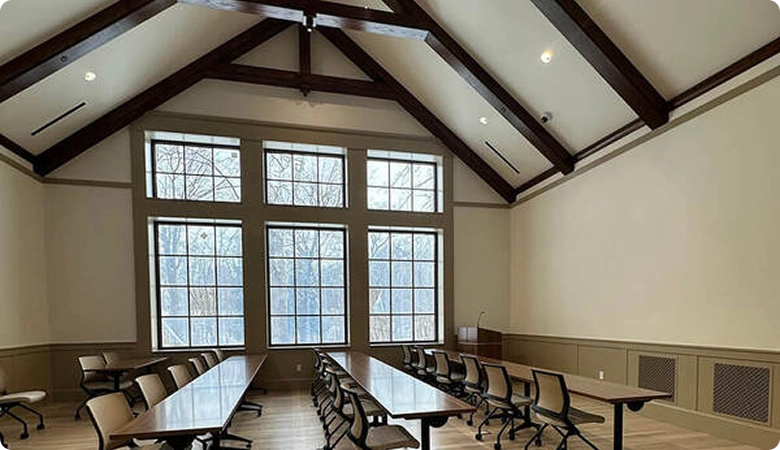
The Welcome Center provides office spaces for HARC staff, a meeting room, a kitchen, and several seating areas designed for connection and conversation. The new building was built to the construction standard approved by the Society of American Archivists and, in the spirit of Laudato Si', as environmentally friendly as possible. The building includes a secure, climate-controlled archival storage vault, offices and workspace for employees, a room that can accommodate both classes and researchers, and two exhibition spaces.
The exhibition spaces will offer students and visitors a tangible encounter with the lived experience of women religious. One exhibition space will include permanent exhibits documenting the history and charism of the member congregations. The other will house rotating, temporary exhibits drawn from the collections.
A key issue for HARC was determining a sustainable funding model. Each member congregation made an initial deposit on an entrance fee to fund the planning process, which included legal fees, financial cost projections, engineers, and other consultations. In addition to the entrance fee, HARC asked each congregation for two additional contributions—one to fund the actual construction and one to set up an endowment for operational expenses. The amount of each contribution was based on the linear feet of each collection. HARC is also actively seeking out grants and donations to fund preservation activities and exhibitions.
In 2025, HARC moved from vision to implementation with the hiring of its founding executive director and professional archival staff, including a lead archivist and a congregational archivist. Barbara Gordon was hired as executive director of HARC, bringing leadership experience and non-profit expertise from her prior work as a library director in Michigan. Shortly thereafter, JA Pryse was hired as lead archivist. He previously served as curator at the Carl Albert Congressional Research and Studies Center at the University of Oklahoma and specializes in digital preservation and metadata design. Jennifer Head was hired as the congregational archivist. She previously served as congregational archivist for the Sisters of Charity of the Blessed Virgin Mary in Dubuque, Iowa, and has consulted with several religious congregations. She has been involved with HARC since 2018.
"What began as a collaborative dream among congregational leaders is now guided by trained professionals."
This transition marked a significant turning point: A collaborative vision among congregation leaders is now overseen by trained professionals responsible for the demanding work of accessioning, preservation planning, policy development, and research services.
Throughout the remainder of the year, the HARC team will focus primarily on the coordinated delivery of collections from the ten member congregations. This represents a remarkable logistical undertaking. Decades, sometimes more than a century, of records, photographs, artifacts, textiles, and institutional memory are being carefully prepared, inventoried, and transported to their new, forever home.
Exchange and Trust
HARC is not only a collaborative effort among its ten member congregations. It is also exploring ways to collaborate with other archives housing the collections of women religious. There are currently three other archives in the United States undertaking this work: the Catholic Religious Archives (CRA) at Boston College, Archives & Special Collections (A&SC) at Santa Clara University, and the Women Religious Archives Collaborative (WRAC) in Cleveland, Ohio. All four archives are part of the National Archives Project for Women Religious (NAPWR), which provides coordinated assistance to congregations in archival planning, amplifies awareness of the need to protect these collections, and increases accessibility through digital linking of repositories.
The stories preserved and shared at HARC are not limited to Catholic history. They document women's history, revealing ordinary women doing extraordinary things and responding to the needs of the times. These stories include the history of education, health care, and social services. Catholic schools, hospitals, orphanages, and other such organizations were often the first to be established in cities and towns, shaping those local histories as well. The records in HARC also document the westward expansion and "Manifest Destiny" of America. HARC allows apostolic women religious to share their story, in their own words, and demonstrate how this story fits into larger historical narratives.
For students and scholars across the tri-campus community, HARC will provide experiential learning opportunities through archival internships, course-integrated research projects, public history initiatives, and digital humanities collaborations. In this way, HARC functions not only as a guardian of memory but also as a cultural center, one that fosters dialogue across generations, between scholars and sisters, and between past and present. HARC seeks to create a space where the charism and courage of women religious continue to inspire new generations of students and supporters.
"While HARC is building a facility, it is also building a sense of trust among the member congregations."
Most discussions about the future of congregational archives in America center on some form of collaborative model. These collaborations require careful planning and, more importantly, trust. HARC members have worked together for over seven years. Despite the challenges of the COVID-19 pandemic, this shared commitment has allowed the project to continue moving forward. As congregations across the United States face questions about aging membership and long-term stewardship of their archives, initiatives like HARC offer a hopeful path forward. By pooling resources while respecting congregational identity, HARC demonstrates that preservation and accessibility need not be mutually exclusive. Instead, shared commitment can strengthen both.

Engage With the Legacy
HARC offers multiple ways to explore, learn, and connect with the legacy of women religious.
Visit & Experience
Explore exhibitions and guided visits that connect you to the stories and impact of women religious.
.webp)
Research the Collections
Access archival materials and primary sources that support academic study, writing, and discovery.
.webp)